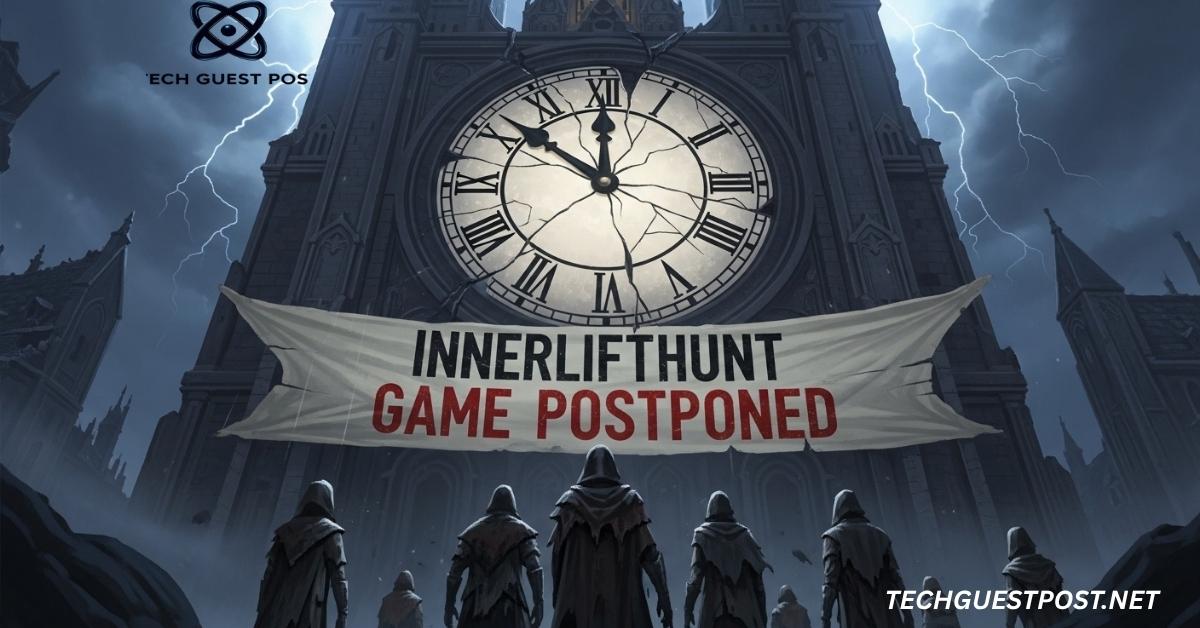
Why Innerlifthunt Game Postponed – Full Breakdown of the Real Reasons
Have you been refreshing your feed for months waiting for Innerlifthunt to drop? You’re not alone. Thousands of fans were counting down the days, clearing their schedules, and hyping up their gaming groups, only to get hit with the news that the release was being pushed back. Again. So what actually happened? Is it canceled? Is it still coming? Let’s break it all down, clearly and honestly.
The Hype Behind Innerlifthunt: Setting the Stage
When Aetherflux Studios first revealed Innerlifthunt, the gaming world took notice fast. This wasn’t just another RPG. It promised something genuinely different, a narrative-driven gaming experience wrapped around psychological depth, moral choices, and emotional gameplay that actually meant something. Players weren’t just fighting enemies. They were confronting inner conflicts, processing trauma through interactive storytelling, and navigating a futuristic RPG gameplay world that blurred the line between fiction and self-reflection.
The trailers were cinematic. The community forums exploded. Gaming journalists called it one of the most ambitious indie game studio projects in years. That kind of momentum is rare. It builds real expectations, real emotional investment, and real disappointment when things go sideways.
So when the delay hit, the silence from the studio felt louder than any announcement. People wanted answers. And they deserved them.
Read More: Hosted Event PBLGamevent: How Gaming Events Are Organized
The Official Announcement: A Carefully Worded Delay
Aetherflux Studios didn’t just post a casual tweet. Their official statement was measured, thoughtful, and, if you read between the lines, surprisingly candid. They acknowledged that the game wasn’t meeting the internal standards they’d set for it. They cited a combination of technical and creative challenges without pointing fingers at any single issue.
What they didn’t do was give a firm new date. That’s always a red flag for a certain type of fan. But it’s also a sign of a studio that’s being honest rather than reckless. Overpromising and under-delivering has buried better studios than Aetherflux. They chose a harder road: saying less, delivering more.
The innerlifthunt release date update essentially became “when it’s ready,” which satisfied almost no one in the short term but made sense as a long-term strategy.
1. Creative Overload: Innovation at a Cost
Here’s where things get genuinely interesting. One of the biggest innerlifthunt development problems was something the gaming industry calls feature creep. It’s when a dev team keeps adding ideas, mechanics, and systems because they’re passionate and the concept keeps evolving. Sounds good in theory. In practice, it’s chaos.
Innerlifthunt started with a core loop, explore your psyche, face moral dilemmas, shape your character through lived emotional experience. Clean. Focused. Then the team started layering in more. Branching dialogue trees that responded to psychological profiling. Dynamic world-building that shifted based on player mental state. Memory-driven NPC behavior. Procedural narrative events.
Each addition was brilliant on its own. Together, they created a system so complex that QA teams couldn’t keep up. Game testing and QA issues multiplied. One patch fixed three things and broke five others. The creative game design limitations of trying to do everything at once started showing up as real, tangible bugs in the build.
The why innerlifthunt game postponed question has a big part of its answer right here. When innovation outpaces infrastructure, something has to give. And usually, that something is the release date.
2. AI Integration: A Double-Edged Sword
Innerlifthunt leaned heavily into AI in video games in a way most titles haven’t attempted. The AI wasn’t just controlling enemy behavior. It was reading player decisions, emotional patterns, and narrative choices to dynamically generate responses across the entire game world. Think of it like having a game master inside the system that actually learns you.
The concept is extraordinary. The execution exposed serious innerlifthunt AI system issues that couldn’t be patched with a hotfix. The system was producing outputs that were inconsistent, occasionally nonsensical, and in some cases emotionally jarring in unintended ways. For a game built on immersive storytelling games and psychological RPG games mechanics, that’s not a minor bug. That’s a foundational problem.
The team had to essentially rebuild portions of the AI architecture while keeping the rest of the game intact. Imagine renovating the foundation of a house while people are still living inside it. That’s what this looked like behind the scenes. Advanced gaming technology is only an asset when it works reliably. When it doesn’t, it becomes the biggest obstacle in the room.
3. Mental Health and Ethical Considerations
This is the part that doesn’t get talked about enough in gaming coverage. Innerlifthunt deals directly with themes of anxiety, depression, grief, identity, and psychological trauma. It’s not window dressing. These themes are woven into the core mechanics of the game. And the team at Aetherflux took that responsibility seriously, maybe more seriously than any studio has before.
During beta testing, some players flagged that certain sequences felt too real. Not in a good way. In a way that blurred the line between engaging emotional gaming experience and potentially harmful psychological exposure. The studio brought in mental health consultants, reviewed dozens of flagged sequences, and reworked sections that could trigger distress without adequate context or safeguarding.
This is ethical game development in action, and it’s messy work. It slows everything down. But it’s the right call. A game that causes real psychological harm to vulnerable players isn’t a success, no matter how critically praised it becomes. Aetherflux made the harder, slower, more responsible choice. That matters.
4. Platform Performance Issues
Here’s something that flew under the radar. Innerlifthunt was designed to run on PS6, Xbox Nova, and high-end PC simultaneously. Cross-platform performance issues became one of the quieter but more stubborn blockers in development. What ran beautifully on one system stuttered or crashed on another. The game’s AI systems, particle effects, and real-time environmental rendering were simply too demanding for a one-size-fits-all optimization approach.
Innerlifthunt performance issues on PS6 and Xbox Nova were significant enough that the team had to build platform-specific optimization pipelines. That kind of work isn’t glamorous. It doesn’t make for exciting developer diaries. But without it, you end up with a broken launch and review scores that sink a game permanently.
Game optimization problems at this scale take time. There’s no shortcut. And given that the emotional and narrative depth of this game depends entirely on technical stability, a frame rate drop at the wrong moment kills immersion completely, the team had no choice but to get it right.
5. Financial Strategy and Industry Timing
Let’s be real about something the gaming industry rarely admits publicly. Release timing is a business decision as much as a creative one. The innerlifthunt investor strategy delay is a genuine factor here. Launching in a window crowded with major AAA titles is commercial suicide for an indie studio, no matter how good the game is.
Video game market competition in 2026 has been especially fierce. Several massive franchise titles dropped or were announced for release in windows that originally overlapped with Innerlifthunt. Aetherflux, working with their investors and publishing partners, made the strategic call to step back and wait for a cleaner window. It’s not a sign of weakness. It’s just smart business.
There’s also the matter of game industry delays being normalized post-pandemic. Development timelines stretched everywhere. Costs rose. Talent was harder to retain. For a studio building something as labor-intensive as Innerlifthunt, all of those pressures compounded in real time.
Limited Subheadings, Deeper Sections
Behind Closed Doors: Voices From the Dev Team
A few developers at Aetherflux have spoken candidly in indie game forums and podcast appearances, though never officially. What comes through consistently is a team that’s exhausted but deeply committed. One developer described the project as “the hardest thing we’ve ever built and the thing we’re most proud of.” Another mentioned that the delay felt painful but necessary, saying the version they would have shipped six months ago wasn’t the game they set out to make.
That kind of candor from a dev team is rare. It tells you something about the culture inside the studio. These aren’t people burning through the project to collect a paycheck. They care about player experience design in a way that’s almost uncommon in the current industry landscape. The innerlifthunt developer interview insights that have surfaced paint a picture of a studio under pressure but not in crisis.
Community Response: A Mixed Yet Hopeful Crowd
The innerlifthunt delay community reaction was predictably divided. On one side, you had the frustrated fans who’d planned around the original date, who’d been hyping the game to friends, who felt let down by yet another gaming delay. Their frustration is valid. No one likes waiting.
On the other side, a surprisingly vocal section of the community rallied around the studio. Comments like “take your time, get it right” and “this game deserves to be finished properly” flooded social media. Long-form posts defending the delay, citing past examples of rushed games that launched broken and never recovered, gained serious traction.
The gaming community has grown, in many ways, more patient and more informed. Players remember Cyberpunk 2077. They remember No Man’s Sky at launch. They know what a broken release looks like and what it costs everyone involved. Many of them are genuinely rooting for Innerlifthunt to be the exception, not another cautionary tale.
A New Release Window and What’s Next
The innerlifthunt future release window hasn’t been locked in officially, but signals from the studio suggest a late 2026 or early 2027 target. Aetherflux has been quietly active, sharing development progress in small, controlled drops rather than big splashy announcements. That approach suggests they’re managing expectations carefully and deliberately.
The innerlifthunt development news from recent months has been encouraging. The AI system overhaul is reportedly complete. Platform optimization has passed internal benchmarks. And the mental health review process has wrapped its second full pass through the narrative content. What’s left is polish, localization, and final QA cycles.
If that timeline holds, the wait will have been worth it. And frankly, given everything this game is trying to do, it needs to be extraordinary to justify the delay in the eyes of its community.
Final Thoughts
The reasons why Innerlifthunt game postponed aren’t simple and they’re not the result of carelessness. They’re the result of ambition colliding with reality, which is the most honest story in all of game development. Feature creep, AI complexity, ethical responsibility, platform performance, and smart market timing all played a role.
What makes this story different from most delay narratives is the studio’s evident sincerity. Aetherflux isn’t hiding behind corporate language. They’re building something genuinely unusual in the modern gaming landscape: a psychological RPG that treats its players as thinking, feeling human beings. Getting that right matters more than getting it out fast.
If you’ve been waiting, keep waiting. This one’s worth it.
FAQ’s
Why was Innerlifthunt postponed in 2026?
The game was delayed due to a combination of feature creep, AI integration issues, ethical review of psychological content, platform performance problems, and strategic market timing decisions by Aetherflux Studios.
Is Innerlifthunt canceled or just delayed?
It’s delayed, not canceled. The studio has confirmed ongoing development with active progress updates shared across their community channels.
What platforms will Innerlifthunt be available on?
Innerlifthunt is planned for PS6, Xbox Nova, and PC, though cross-platform optimization was one of the key challenges that contributed to the delay.
What kind of game is Innerlifthunt?
It’s a psychological RPG with narrative-driven gameplay, emotional storytelling, and AI-powered systems that adapt to player decisions and mental state throughout the experience.
When is the new Innerlifthunt release date?
No official date has been confirmed yet. Current indicators from the studio suggest a late 2026 or early 2027 launch window, pending final QA and polish.

Evan Cole is a tech enthusiast and digital strategist with years of experience in content marketing and SaaS trends. He explores emerging technologies, AI innovations, and SEO-driven growth strategies. Evan’s insights help readers understand complex tech topics through practical examples and real-world applications that inspire smarter digital solutions.